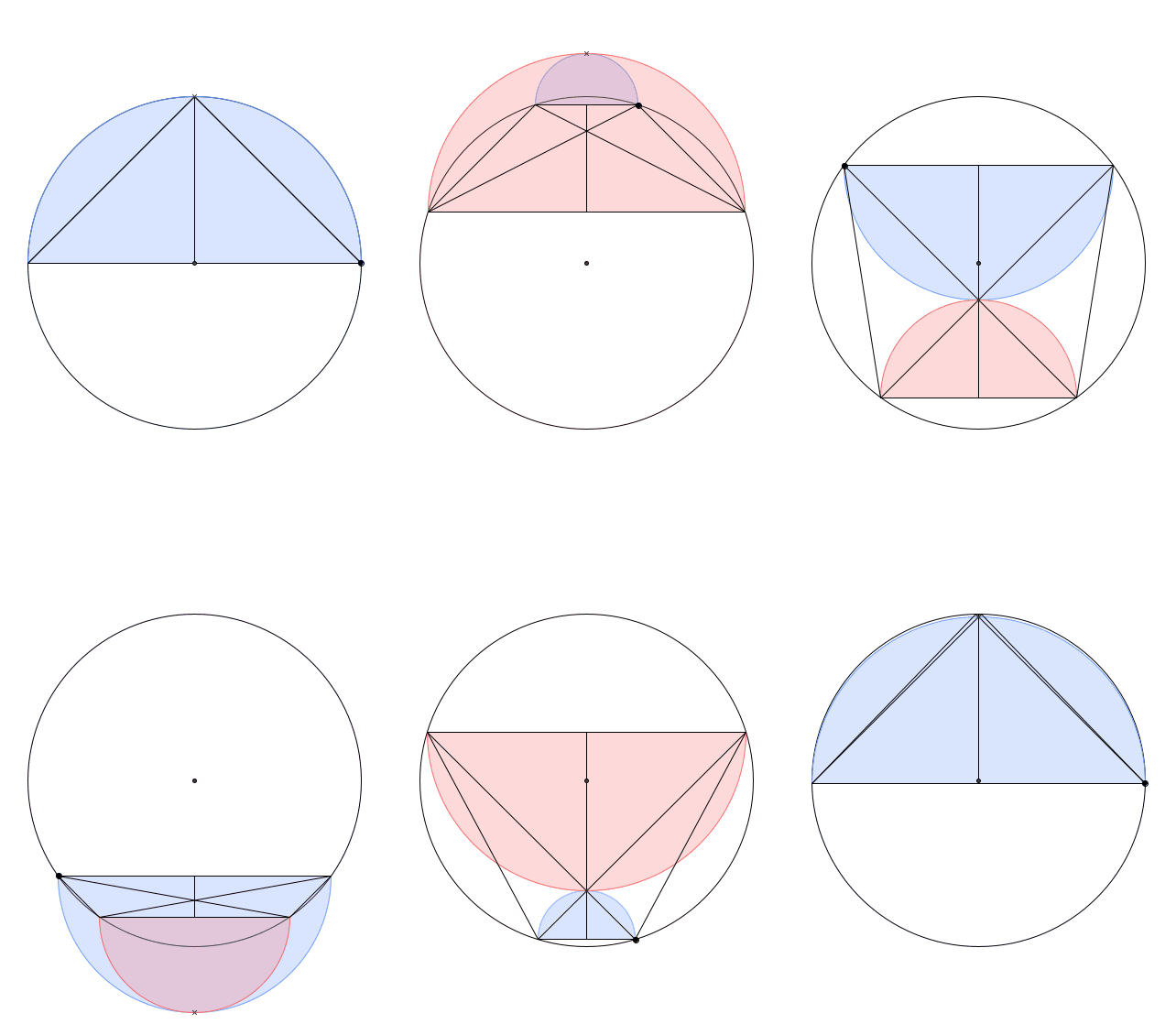
To determine the area of two tangent semicircles on parallel chords.
Let AB and CD be the parallel chords, K the center of the circle, and T the point of tangency. Drop the
perpendicular KL to CD and produce it through to meet AB at M. Join TB, TC, TD, and BD. Drop the
perpendiculars KE to TC and EF to LM.
The chords AB and CD are perpendicular to LM which passes through K, so LM bisects them both; it is thus the
line of centers of the semicircles, and so passes through the point of tangency T. Triangle TLC is an isosceles right
triangle, so angle LTC is half a right angle, as also is BTM. Since these angles are equal, BT and TC are in one
straight line. The chord BD subtends half a right angle at C on the circumference, and so a right angle at the centre K;
it is the side of the inscribed square.
Angle CTD is the angle in a semicircle, so DT is perpendicular to CT. The square on BD is then the sum of the
squares on TB and TD, but the square on the diameter is twice the square on BD, the square on AB is twice the
square on TB, and the square on CD is twice the square on TD, so the square on the diameter is the sum of the
squares on the chords AB and CD.
Circles are as the squares on their diameters; thus, circles on the chords AB and CD as diameters
are together to the circle K as the squares on these chords are together to the square on the diameter
of the circle. As the later two are equal, so are the former, and the two semicircles are half the circle.
Q.E.F.
N.B. If the semicircles are tangent internally, the same argument holds, but the diagram is quite different. In
this case, the shorter chord is entirely inside the larger semicircle, and with it the arc of the circle, so
the arcs of the semicircles are outside the circle, and the pairs of points L,M and T,K have changed
places.
In the case of external contact, LM is half the sum of AB and CD, while TK is half their difference; in the internal
case LM is half the difference while TK is half the sum. Clearly, TL and TM are semicircular radii. Further, KE is
perpendicular to BC and angle ETF is half a right angle, so angle EKF is also half a right angle; since triangle TEK
is isosceles and EF is perpendicular to TK, TK is twice TF. Since E is the midpoint of the chord BC and
EF is parallel to CD, F is the midpoint of LM, and so TF is half the difference of the semicircular
radii for external contact, but half their sum for internal contact, and thus TK is half the difference
or half the sum of the chords for external or internal contact respectively. Also, TM is equal to KL.